
The insurance industry has invested billions in artificial intelligence, yet has little production deployment to show for it. Carriers have launched innovation labs, run extensive pilots, and delivered compelling proofs of concept — only to see these efforts stall before reaching enterprise scale. This pattern, now widely known as pilot purgatory, reflects AI initiatives that succeed in demonstrations but fail to translate into operational impact.
The challenge is not a lack of vision or investment. It is a failure of execution. This paper examines why AI pilots fail to scale in insurance, outlines three foundational requirements for production-grade AI, and presents a practical path forward: ServiceNow as the enterprise AI operating system that enforces those pillars, and Naitiv as the specialized delivery partner that enables execution within insurance’s regulatory and operational constraints.
Over the past several years, AI investment in the insurance industry has accelerated rapidly. Global spending reached $9.5 billion in 2024, growing 17.4% year over year, and is projected to hit $15.9 billion by 2027 (Gartner). Leading carriers are backing this momentum with substantial commitments, investing between $25 million and $100 million annually to build AI capabilities (BCG). This surge reflects strong executive conviction: nine in ten insurance leaders now rank AI among their top strategic priorities, and the majority have placed it at the center of their digital transformation agendas for 2025.
Yet despite unprecedented investment and alignment at the top, the industry has struggled to translate ambition into scalable impact. The gap is not driven by technology limitations, but by a deeper structural issue — and it has a name: Pilot Purgatory.
Across the industry, AI initiatives neither advance to production nor shut down. They persist indefinitely, consuming resources without delivering enterprise value. The data tells a consistent story:
Sedgwick's 2025 research reinforces this disconnect: nearly two-thirds of carriers acknowledge a gap between AI ambitions and actual capabilities, and 90% agree that AI must be coordinated across business processes to deliver meaningful returns — an acknowledgment that the siloed POC model is structurally insufficient.
The failure to advance from pilot to production is not primarily a technology problem. It is organizational, architectural, and cultural. Four root causes recur across carriers of all sizes:
Beyond wasted R&D spend, dormant pilots create 'AI debt' — organizational and technical accumulation that makes future scaling progressively harder. The competitive gap widens every quarter that AI leaders pull further ahead.
Carriers that escape pilot purgatory share a common approach: they establish foundational capabilities before — or alongside — AI deployment. These capabilities fall into three pillars.
AI is a force multiplier. Applied to a well-designed process, it accelerates value; applied to a chaotic one, it scales chaos. Before any model is selected, carriers must audit workflows to identify friction, redundancy, and variability — and redesign those processes, not simply automate them.
The most successful deployments follow a domain-based approach: rather than scattering pilots across dozens of use cases, leading carriers focus on transforming entire domains—claims processing, underwriting decisioning, or policy servicing — end to end with AI embedded in reimagined workflows. This domain-based approach, combined with serious investment in change management (McKinsey recommends $1 in adoption support for every $1 in development), is what separates carriers that scale from those that stall.
Domain Transformation in Practice: Aviva
Aviva deployed over 80 AI models within its claims domain between 2023 and 2024, investing 40,000 hours in staff training. Liability assessment time fell by 23 days, customer complaints dropped 65%, and motor claims transformation saved more than £60 million in 2024. The differentiator was not model sophistication — it was domain-wide commitment.
Insurers are data-rich but governance-poor. Decades of claims, underwriting, and customer data remain fragmented across incompatible systems and formats.
Production-grade AI requires a governed ‘data estate’: validated ingestion, standardized transformation, lineage tracking for auditability, real-time access for AI models, and feedback loops for continuous improvement. While unglamorous, this infrastructure is the strongest predictor of whether AI pilots scale.
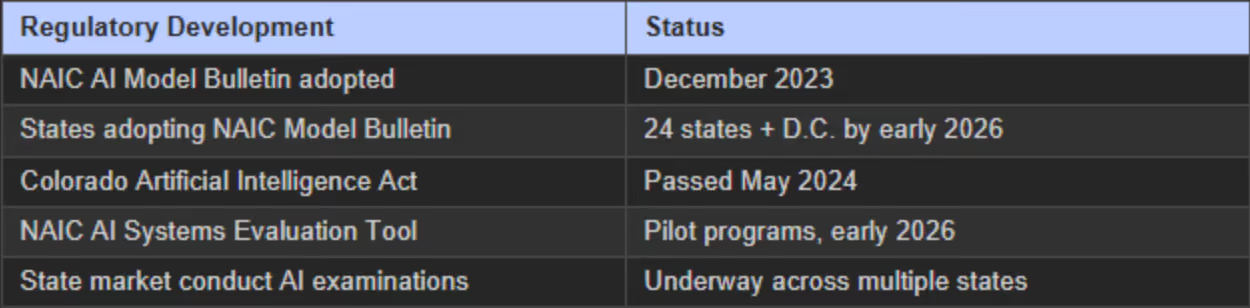
Insurance regulation is not an obstacle to AI — it is a design constraint. The NAIC Model Bulletin on the Use of AI System, adopted in December 2023 and now in force across 24 states and D.C., requires carriers to maintain documented AI governance programs across the full insurance lifecycle — underwriting, claims, pricing, fraud detection, and customer service.
Carriers must build AI governance programs (AIS Programs) that include cross-functional governance structures, model validation and testing protocols, audit trail documentation, third-party vendor oversight, and incident response procedures. States such as Colorado, California, and New York have enacted additional requirements and regulators have already begun examinations focused on compliance. Governance designed into AI from the outset enables faster, more confident scaling.
The three pillars form an operational blueprint. The challenge is executing against them without rebuilding the enterprise, exhausting internal talent, or delaying value realization for years.
The solution is a complementary: ServiceNow as the enterprise AI operating system that structurally enforces the three pillars by design, and Naitiv as the specialized delivery partner that bridges the gap between the platform's potential and the carrier's production reality.
Most AI failures stem from fragmentation—separate platforms for claims automation, fraud detection, and service, each with its own data, governance, and operating model. The result is AI sprawl, not AI transformation.
ServiceNow addresses this structurally: a single platform with one data model and one governance layer across workflows and AI agents. CEO Bill McDermott describes it as 'AI plus data plus workflows on one fully integrated platform that replaces all of the chaos with clarity.' The endorsement from outside ServiceNow is equally compelling:
"Watching the world of enterprise AI, ServiceNow is destined to be the best platform, the operating system of enterprise AI agents."
- Jensen Huang, CEO of NVIDIA — ServiceNow Knowledge 2025
Huang was not promoting a joint product — he was offering an independent assessment of where enterprise AI architecture is heading. For insurance executives choosing which platform to build their AI future on, that perspective carries considerable weight.
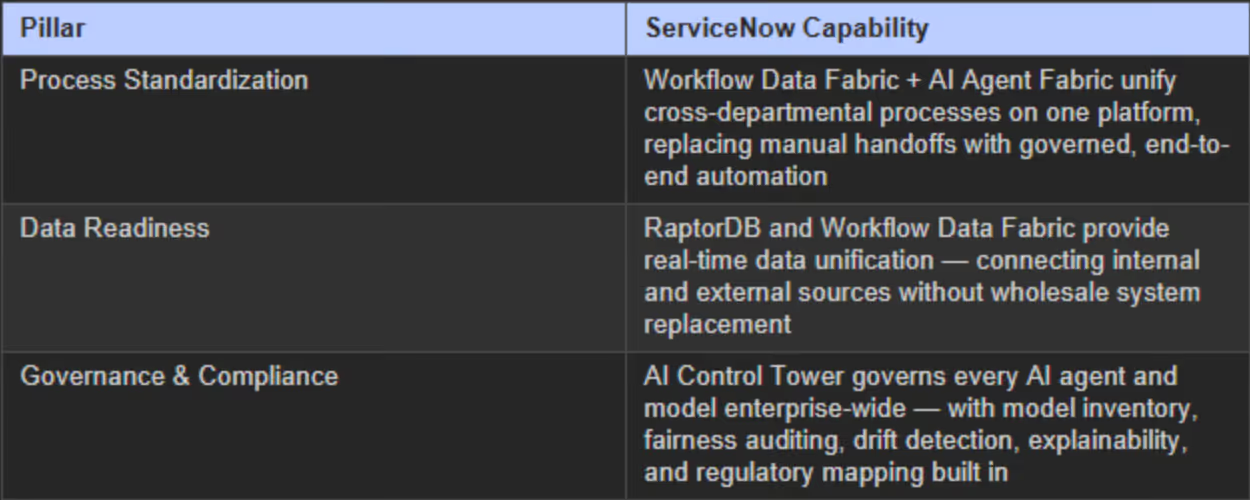
The AI Control Tower is particularly consequential for insurance. It addresses every element regulators increasingly expect insurers to demonstrate: model inventory and documentation, fairness monitoring, explainability of AI-driven decisions, real-time performance tracking, and the audit trails required to satisfy examination inquiries — including for third-party AI models, which are now a specific focus of regulatory scrutiny.
ServiceNow's Financial Services Operations for Insurance module adds purpose-built workflows for claims management, policy servicing, and underwriting. AI agents summarize claims documents, provide real-time status transparency, route complex cases, and automate mid-term policy activities — all within a governed, auditable architecture. The AI Agent Fabric connects these agents across departments, vendors, and legacy systems without requiring those systems to be replaced.
A U.S. specialty insurance carrier implemented the ServiceNow AI Platform to replace a fragmented set of legacy processes across claims and policy servicing. Rather than deploying isolated pilots, the carrier committed to a domain-wide transformation — unifying data, workflows, and AI governance on a single platform. The result was measurably faster response times and case resolution, improved customer satisfaction, and significantly enhanced employee efficiency — within a governed, audit-ready architecture built for regulatory examination from day one.
Even the most powerful platform requires specialized execution. Insurance carriers pursuing AI transformation on ServiceNow face a specific challenge: they need professionals who understand both the platform's technical depth and insurance's operational and regulatory complexity — a combination that is genuinely rare. 70% of insurance CEOs are concerned about competition for AI talent. 52% identify skills and resource constraints as their primary implementation barrier.
Naitiv is a specialized ServiceNow delivery partner purpose-built for this challenge. Where ServiceNow provides the architectural foundation, Naitiv provides what that foundation requires to become operational: platform architecture expertise, legacy system integration, insurance workflow redesign, and governance configuration. Naitiv's role was articulated at InsTech's 2026 insurance AI orchestration event — addressing 'the implementation reality: from architecture and platform expertise to integrating legacy systems and aligning customer and employee workflows' in regulated insurance environments.
Naitiv brings insurance-domain expertise that generic ServiceNow partners cannot replicate. Implementing AI workflows in insurance requires understanding not just how the platform's tools work — but how claims triaging, underwriting submissions, and policy servicing processes operate and where they must be redesigned to deliver domain-wide transformation. Naitiv builds solutions around the business outcome, not the technology feature.
Legacy system integration is where insurance AI most commonly breaks down. Naitiv designs the connectors, data mapping logic, transformation pipelines, and validation controls that turn fragmented legacy data into governed, AI-consumable information — separating a data estate that works from integration that creates new forms of technical debt.
Configuring ServiceNow's AI Control Tower to meet NAIC Model Bulletin requirements, map to state-specific guidance, and govern third-party vendor models requires knowledge of both the platform's governance architecture and the insurance regulatory landscape. Naitiv brings both — ensuring governance infrastructure is examination-ready from day one.
Naitiv's engagement model is also oriented toward knowledge transfer, not dependency. Carriers emerge from implementation not just with a working platform, but with the internal understanding to expand and evolve their AI ecosystem as both the technology and the regulatory landscape continue to develop.
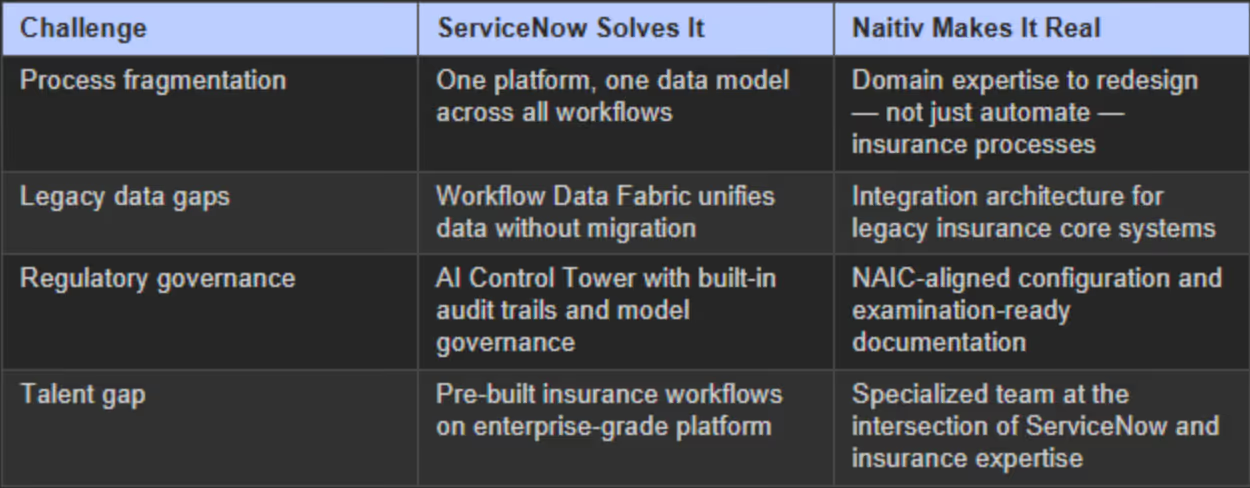
The insurance industry does not lack AI ambition, investment, or use cases. It lacks the structural architecture and specialized execution to move reliably from pilot to production.
ServiceNow provides the enterprise foundation; Naitiv provides the insurance-specific execution. Together, they offer insurance carriers a proven path from strategic intention to operational reality — AI working in production, governing regulated decisions, integrating with legacy systems, and delivering measurable business outcomes across claims, underwriting, and policy servicing.
The carriers who move decisively on this combination in 2026 will not merely escape pilot purgatory. They will build the enterprise AI infrastructure that defines competitive positioning for the decade ahead — on a platform designed to scale, with a partner designed for insurance.
The question for 2026 is no longer 'Should we invest in AI?' That debate is settled. The question is: 'Do we have the right platform architecture to govern and scale AI enterprise-wide — and the right implementation partner to make it real in a regulated insurance environment?' ServiceNow and Naitiv provide a direct and proven answer to both.
.svg)