
M&A on spm

From deal model to realized value

Naitiv runs the M&A deal lifecycle on ServiceNow — from screening a target, through the integration management office, to the synergies landing on the books. It runs on the ServiceNow you already own, so your teams are in it from day one.

Integration value leaks in four predictable places

Decisions live in decks — no owner, no audit trail, no dollar attribution
Synergy commitments lose attribution within a quarter of close
TSA fees outlive their exit dates because nobody owns the exit
The integration playbook leaves with the deal team

One solution for the whole deal lifecycle

The M&A IMO gives you one place to run an acquisition — from screening a target, through the first hundred days after close, to the synergies landing on the books. Deal teams, workstream leads and the executive sponsor work from the same picture, so nothing depends on who remembered to update the deck. It runs on ServiceNow, so your teams are already in it on day one.

Every decision has an owner and a number

Not a line in a deck someone has to go find

Synergy reconciles to the deal model

Committed against realized, traced to the decision that promised it

Nothing leaves with the deal team

The integration record stays in your platform after they move on

Ten stages, one place to run them

Before the deal

01 Strategy
02 Screening
03 Diligence
Candidate screening held as records rather than a folder of spreadsheets, and the acquirer's own estate — applications, contracts, infrastructure, sites — assessed against the target's disclosures. Every finding carries its source and its confidence, because pre-close data is uneven and clean-team gated.

At signing

04 Negotiation and service obligations
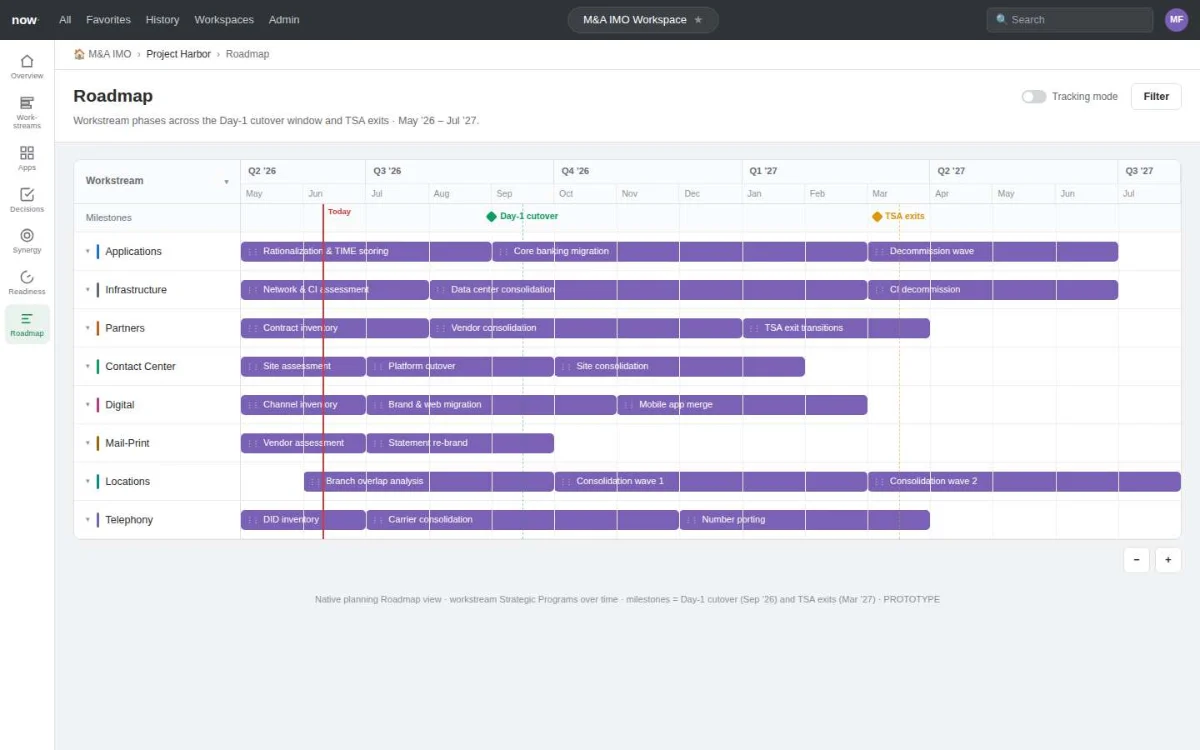
The stage everyone under-plans. Contract tools store a TSA; nobody operationalizes it as a service with a cost, an SLA and an exit date — which is how transition fees outlive their usefulness.

After close

05–10 IMO through value realization
The integration office: inventory, rationalization, readiness, the decision register, promoted work, and synergy reconciled back to the decisions that promised it.

Inventory → Compare → Assess → Decide → Quantify → Execute

This is the operating loop, and it repeats per domain.
01
Inventory
The asset exists as a record before anyone has an opinion about it
02
Compare
Acquirer and target instances of the same capability scored on the same basis
03
Assess
A per-domain readiness rubric, scored against the Day-1 go/no-go
04
Decide
One record per call: what was decided, who owns it, why, and what it is worth
05
Quantify
The decision points at the synergy target that carries its committed value
06
Execute
Work-creating decisions become real work in the system your PMO already runs

In a merger, the decisions are the deliverable

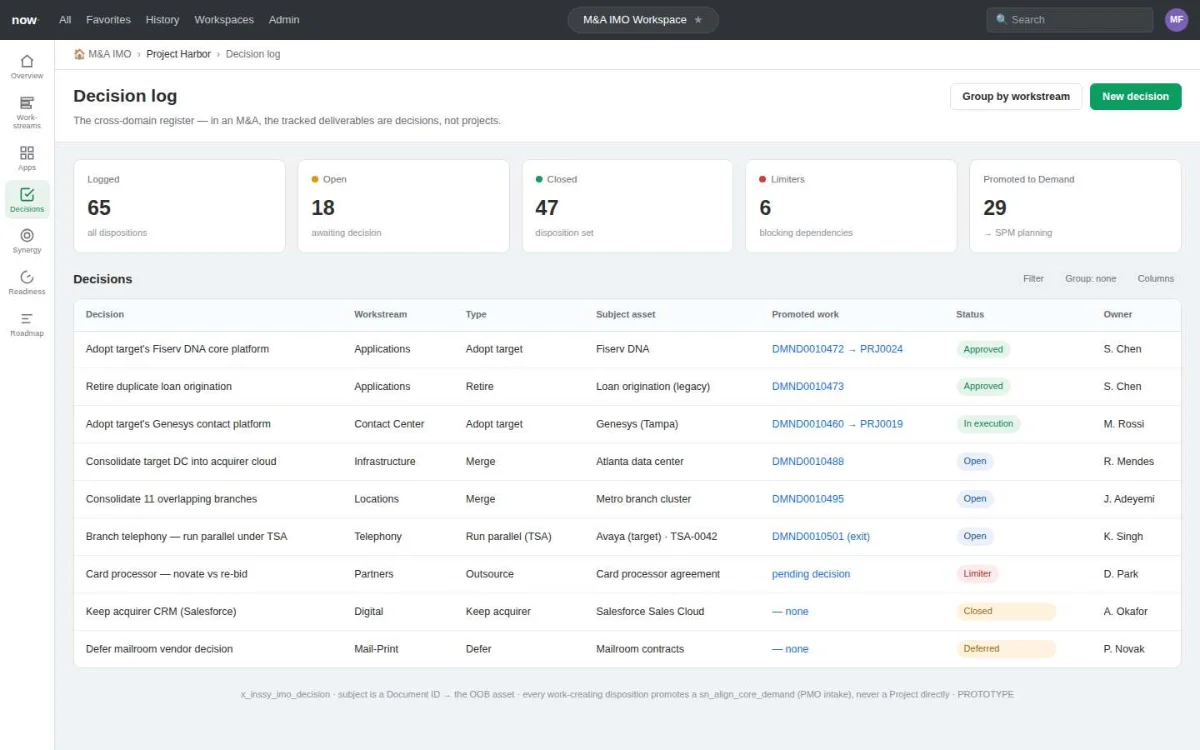
Keep, adopt, merge, retire, replace, outsource, run under TSA, defer. Each one is a single record with an owner, a rationale, a dollar value and a date. Decisions that create work promote into the customer's existing demand intake and are governed exactly as every other demand is.

Keep and Defer create no work at all. They are still decisions, still owned, still in the register. That is the part spreadsheets lose.

One view across every workstream

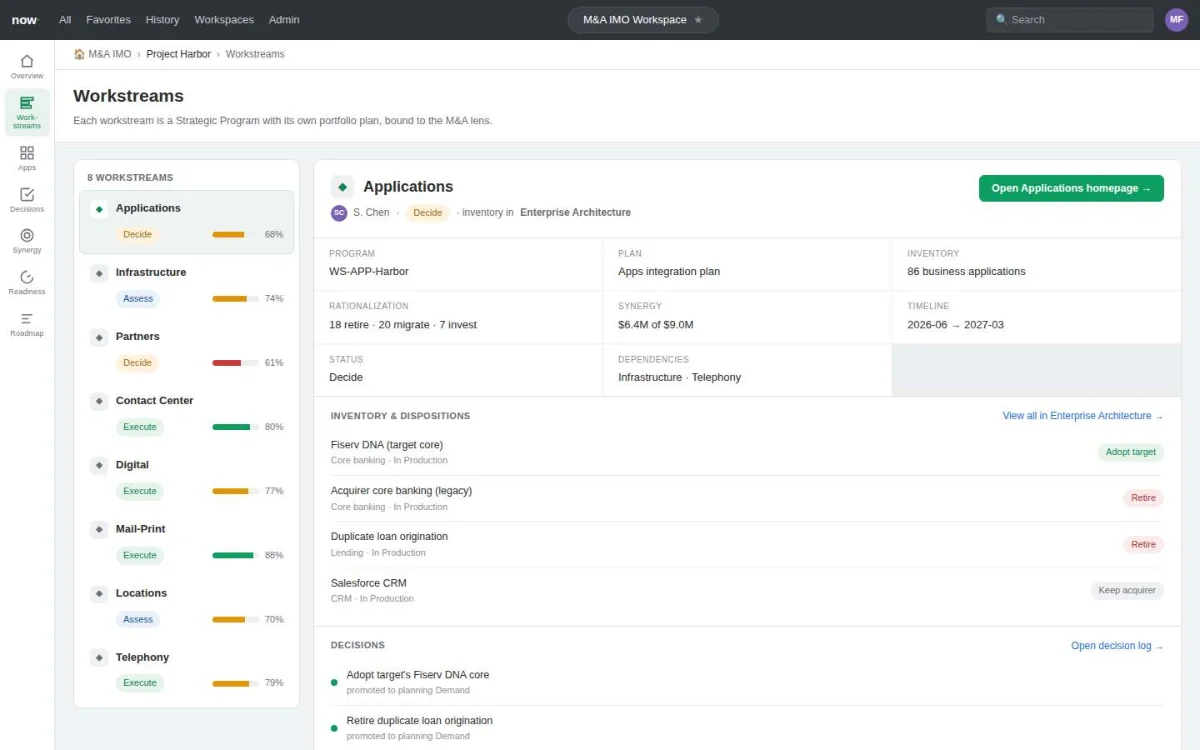
Applications · Infrastructure · Partners · Contact Center · Digital · Mail and Print · Locations · Telephony …and whatever this deal needs

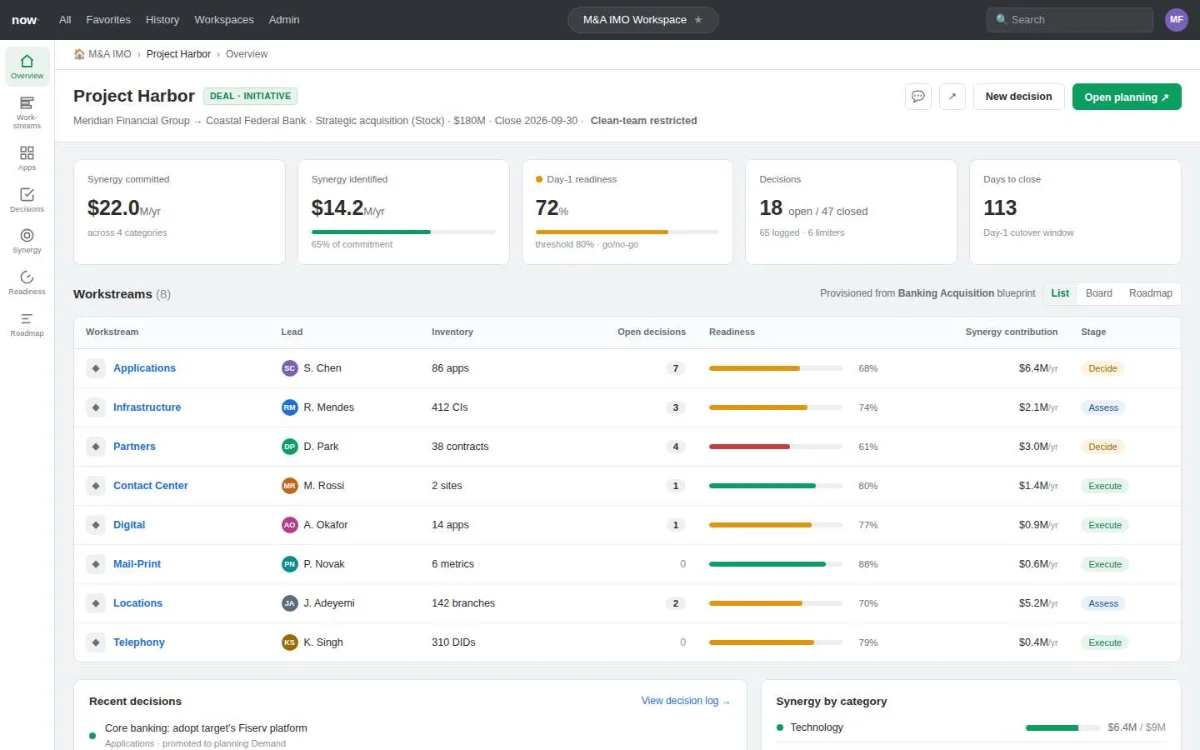
Most integrations run eight or so workstreams, and those are the ones we see most often. Yours might add Manufacturing, Supply Chain, HR, Treasury or Regulatory — the model does not change. Each workstream gets its own lead, its own inventory and its own readiness measure, and every one of them reports into a single view. In the first ninety days after close, that view is what nobody has.
See it working

The deal at a glance — committed against identified synergy, Day-1 readiness, and the eight workstreams
One decision: disposition, the asset it applies to, the work it created, and the rationale
Committed against realized, by category
Standing up a complete integration office in one guided session

Works alongside what you already run

Your deal tooling keeps sourcing and pipeline

We pick up when a target becomes a decision.

Your CLM keeps contract drafting

We track the obligations it creates, and their exits.

Your data room keeps the documents

We hold the assessments made against them.

Your deal model sets the synergy number

We track it to the decisions that deliver it.

See a walkthrough.

Thirty minutes, screen-shared. We walk a $180M bank acquisition end to end through the working system — inventory, rationalization, a decision with its promoted work, synergy, and Day-1 readiness.
Contact us